


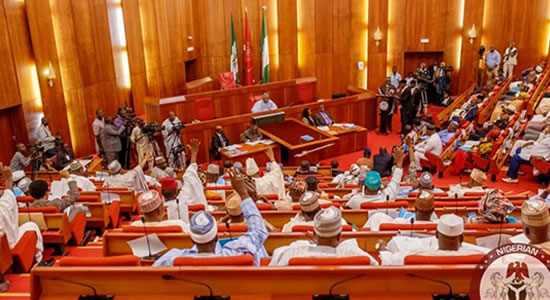
The proposal by Senate Leader Opeyemi Bamidele to sponsor a bill introducing a single six-year tenure for presidents and governors after the 2027 general elections has generated widespread debate, with many Nigerians expressing concerns that it could pave the way for incumbents to remain in office longer than currently permitted under the Constitution.
Bamidele recently disclosed during an interview with journalists in his office that the proposed legislation would be among the first bills he plans to introduce when the next Senate is inaugurated. According to him, the reform would allow elected leaders to focus more on governance by removing the distractions associated with seeking re-election.
He argued that under the existing two-term arrangement, office holders often spend a significant portion of their first tenure preparing for another election cycle, a situation he believes undermines effective governance.
However, reactions to the proposal have been mixed, with critics questioning its underlying motives. Although Bamidele did not indicate whether the proposed law would apply to current office holders, many observers fear it could be exploited by politicians serving their final constitutionally permitted terms.
Others, however, believe a single tenure system could help leaders concentrate fully on delivering good governance without the pressure of securing a second mandate.
Constitutional Amendment Required — Lawyer
A Kano-based legal practitioner, Barrister Kamilu Ahmad-Paki, said the proposal cannot become law without significant amendments to the 1999 Constitution.
Speaking on the matter, Ahmad-Paki confirmed that Senate Leader Opeyemi Bamidele intends to back the bill in the 11th National Assembly.
He explained that the Constitution currently provides for a four-year tenure, renewable once, for both the president and state governors.
“Section 137 of the 1999 Constitution establishes the office of the president and sets out that the president shall spend a four-year term in office, with the possibility of re-election for another four years. Similarly, Section 180 provides that governors shall serve four years and may be re-elected once. If this bill is to see the light of day, these sections must be altered,” he said.
Ahmad-Paki further noted that Section 182 prevents governors from serving more than two terms, while Section 137(1)(b) imposes a similar restriction on presidents.
He added that the tenure of local government councils under Section 7 may also require adjustment to align with the proposed framework.
According to him, constitutional amendments face a rigorous process under Section 9, which requires the support of two-thirds of members of the National Assembly and approval from at least 24 state Houses of Assembly.
“If that majority is not achieved, the bill will not see the light of day,” Ahmad-Paki concluded.
Critics Question Motives Behind Proposal
Senior Advocate of Nigeria, Abeni Mohammed, criticised the initiative, suggesting that some lawmakers are acting in pursuit of political survival rather than national interest.
“They are looking for self-survival before they are booted out naturally or by a violent revolt,” he said.
Mohammed also expressed frustration that lawmakers are discussing tenure reforms while the country grapples with severe security challenges.
“The issue of insecurity is more important to me than all the nonsense coming out from the Senate. School children and their teachers have been kidnapped for days and are still in the forest, and the only thing they are talking about is seeking provision for a single term. Do they even deserve one term?
“What have they done since they have been there except passing useless bills and approving loans, both foreign and domestic, for the president,” he added.
Another Senior Advocate of Nigeria, Salam Jawondo, said the proposal would only succeed if it secures the constitutionally required support from both the National Assembly and state legislatures.
He observed that the measure may struggle to gain traction if lawmakers do not consider it a priority.
Addressing concerns that the bill could be used to extend the tenure of current office holders, Jawondo maintained that constitutional provisions limiting presidents to two terms remain in force unless formally amended.
“I doubt such an amendment will scale through,” he said.
Jawondo further argued that Nigeria faces more pressing concerns, including insecurity and economic hardship, warning against allowing political debates to overshadow governance.
“My advice is that every politician should concentrate more effort on solving the prevailing problems, especially insecurity,” he added.
Political Analyst Suspects Hidden Agenda
Also reacting, a political scientist based in Niger State, Dr Kamar Hamza, said while the proposal could have genuine governance objectives, its timing has raised questions.
“Who knows, maybe he is being used as a conduit by politicians to actualise their plans. There may be some hidden agenda,” he said.
The proposal continues to generate debate across political and legal circles, with supporters highlighting its potential to improve governance, while critics remain concerned that it could be a precursor to broader efforts aimed at altering Nigeria's current tenure framework.
Six-Year Single Term Could Cut Election Costs, Encourage Bold Leadership — SAN
A Senior Advocate of Nigeria (SAN), Sunusi Musa, has backed the proposal for a single six-year tenure for presidents and governors, arguing that it could reduce the cost of elections and allow leaders to make difficult policy decisions without worrying about re-election campaigns.
Speaking in an interview with our correspondent, Musa said the proposal should be viewed as part of Nigeria's ongoing constitutional development process, noting that citizens have the right to amend the constitution through their elected representatives.
According to him, the idea is not new, recalling a similar proposal made during the administration of former President Goodluck Jonathan.
“This is not the first time that the issue is coming up. If you may recall, President Jonathan proposed something like that, which he clearly said he would not be a beneficiary of. But it was rejected by Nigerians at that time,” he said.
Musa emphasised that constitutional amendments have been a recurring aspect of Nigeria's democratic evolution since 1999.
“The constitution is an evolving document. The people that are governed by the constitution have the right, through their representatives at both national and state assemblies, to look at it and see if there are things that need to be amended,” he said.
The senior lawyer maintained that adopting a single six-year tenure would lessen the frequency of elections and reduce associated expenses.
“If we look at it critically, it will reduce the cost of elections. The money that you normally spend in eight years can only be spent in 12 years if you make it six years. So, it means that you have reduced the cost of election by four years in two terms,” he said.
He further argued that leaders would be able to focus more on governance if they were not preoccupied with securing a second term.
“Maybe it will give those in power the concentration to do what is right because when somebody is concerned with running for a second term, there are things he is supposed to do which he will be thinking of the consequences for because of his second term.
'What I am saying is leadership requires taking painful but necessary decisions. Most politicians are prevented from making such decisions because they are considering elections,” he added.
On whether current office holders could benefit from the proposed arrangement, Musa said the determining factor would be the language of any constitutional amendment establishing the new tenure system.
“It is for the new alteration to clearly state that any person that has been a governor or president for eight years is precluded from benefiting,” he said.
He cautioned that without such safeguards, incumbents could potentially seek an additional six-year term under the new framework.
Reflecting on the rejection of Jonathan's earlier proposal, Musa attributed the outcome largely to public suspicion.
“The mistrust was the thinking that it was going to be done for him to do four years and then stick on a six-year term. That was what killed the entire thing,” he said.
He urged Nigerians to assess the proposal on its merits rather than on the personalities behind it.
“Let us look at it critically. Politicians should be statesmen and critically examine it. Rejecting it simply because we do not like the face of the person bringing it is not the right approach,” he said.
Musa also noted that the proposal is constitutionally achievable if it secures the support of two-thirds of members of the National Assembly, approval from at least 24 state Houses of Assembly, and presidential assent.
However, another constitutional lawyer, Barrister Morakinyo Ogele, expressed strong reservations about the proposal, suggesting it could be designed to extend the tenure of current political office holders.
“You know, the president is in control of everything now. It is another avenue for tenure elongation for Tinubu and the governors. It’s just a strategy for tenure elongation.
“So, let me tell you, we are fed up with them. We don’t believe in them anymore. They are just there doing what they like. It’s a strategy. We have become the national house of APC, period,” he said.
Ogele also questioned the likelihood of the proposal succeeding, arguing that those behind it may be uncertain about their electoral prospects in future elections. While acknowledging the constitutional powers of the National Assembly to amend the constitution, he urged lawmakers to exercise caution in pursuing such changes.
Six-Year Single Term Not a Cure for Nigeria’s Challenges — Analyst
Public affairs commentator David Adenuga has urged Nigerians to critically examine the proposal for a single six-year tenure for presidents and governors, stressing that the debate should focus on its implications for governance, accountability, and national development rather than partisan politics.
Speaking on the proposal, Adenuga said the central issue should be whether the suggested tenure structure would deliver better outcomes than the current system that allows elected leaders to serve two four-year terms.
“The key question is whether a single six-year term will improve accountability, governance and national stability better than the current system of two four-year terms,” he said.
He argued that the effectiveness of any democratic system depends more on the quality of institutions, credible electoral processes, and competent leadership than on the duration of political tenures.
According to him, although supporters of the proposal believe it could minimize the distractions that often accompany re-election campaigns, the public must carefully weigh its potential advantages against possible shortcomings.
Adenuga noted that the idea is not entirely new, pointing out that similar proposals have surfaced in the past and have consistently generated public discussion and debate.
He emphasised the need for extensive consultations and an objective assessment of the proposal before any move is made to amend the constitution.
“Whether a single six-year term is better than the current arrangement remains a matter of debate. What is important is choosing a system that will strengthen democracy and improve governance,” he added.
The analyst also called on lawmakers and other stakeholders involved in constitutional and electoral reforms to prioritise national interest above political considerations as discussions on the proposal continue.