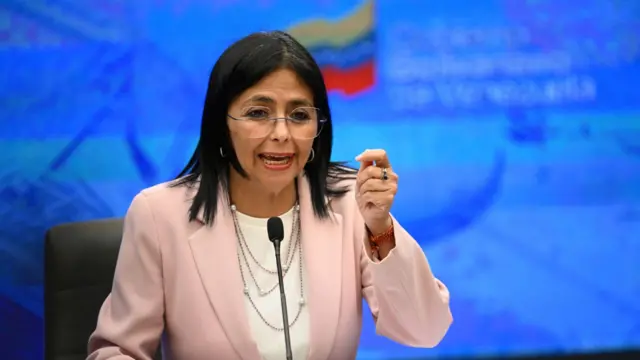
Delcy Rodríguez was sworn in as Venezuela’s interim president during a parliamentary session overshadowed by demands for the release of ousted leader Nicolás Maduro, who is in US custody following a weekend raid. Thousands gathered outside the Federal Legislative Palace in Caracas as lawmakers convened amid heightened international tensions. Rodríguez, 56, who has served as vice president since 2018, said she took the oath “with pain,” denouncing what she called the "kidnapping" of Maduro and his wife, Cilia Flores. She described the US operation as "illegitimate military aggression" and pledged to guarantee peace and "the spiritual tranquility of our people, the economic and social tranquility of our people."
Hours earlier in New York, Maduro appeared in federal court, insisting he remained Venezuela's president as he pleaded not guilty to charges including narco-terrorism conspiracy, cocaine importation conspiracy, and weapons offences. "I'm a decent man. I am still president of my country," as he was led away in shackles. Judge Alvin Hellerstein interjected that there would be a "time and a place to get into all of this."
The arrest drew sharp exchanges at the United Nations, where Venezuela's ambassador Samuel Moncada accused Washington of an "illegitimate armed attack lacking any legal justification." U.S. Ambassador Mike Waltz defended the action as a "surgical law enforcement operation," describing Maduro as "an illegitimate so-called president" and a "fugitive from justice," adding that vast energy reserves could not be left in such hands.
US President Donald Trump said more than 150 aircraft and 200 personnel took part in the operation and vowed the United States would “run” Venezuela until “a safe and proper, and judicious transition” was possible. However, Senate Minority Leader Chuck Schumer later criticised the plan as “vague, based on wishful thinking,” warning, “When the United States engages in this kind of regime change and so-called nation building, it always ends up hurting the United States.”
House Speaker Mike Johnson rejected claims of regime change, calling the operation “decisive and justified” and arguing the US was demanding “a change of behaviour by a regime.” He pointed to seized oil exports as leverage, while Trump said US oil companies would move in to repair infrastructure and “start making money for the country.”
Despite Washington’s stance, Maduro’s allies retain control in Caracas. Trump warned Rodríguez she could “pay a very big price” if she failed to “do what’s right,” while Rodríguez signalled limited cooperation, saying: “We invite the US government to collaborate with us on an agenda of co-operation oriented towards shared development within the framework of international law.” Maduro’s son told parliament his parents “will return” and pledged “unconditional support” for Rodríguez.
Maduro’s next court hearing is scheduled for 17 March.