


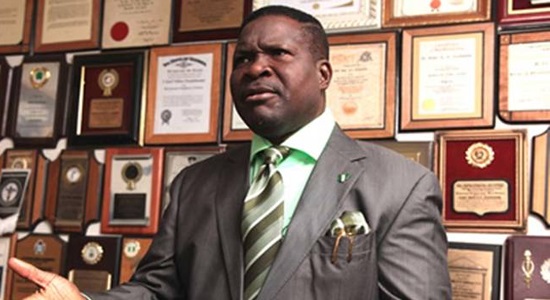
The appointment of retired Major General Adeyinka Famadewa as Special Adviser on Homeland Security has triggered fresh conversations about the evolving structure of Nigeria’s security framework under President Bola Ahmed Tinubu’s administration. President Tinubu, who is currently out of the country, confirmed the appointment in a circular released on Monday. The notice was signed by the Secretary to the Government of the Federation, George Akume, and issued by the Permanent Secretary of the General Services Office, Ibrahim Kana.
In the statement, Akume said the appointment reflects the administration’s resolve to reinforce internal security coordination amid rising concerns over insecurity across different parts of the country.
He explained that the move is aimed at improving intelligence-led operations and fostering stronger collaboration among security agencies.
According to Akume, the appointment “underscored the commitment of Tinubu’s administration to strengthening internal security coordination, enhancing intelligence-driven operations, and deepening inter-agency collaboration in addressing emerging security threats across the country.”
The development has since generated debate among political observers and security analysts, with many questioning what the new role could mean for Nigeria’s existing security structure and how it may shape the government’s broader response to insecurity.
Famadewa’s appointment comes at a time when the administration is under increasing pressure to tackle persistent security challenges, including insurgency, banditry, kidnapping, and communal violence in several parts of the country.
Nigeria has, in recent times, witnessed growing security challenges, with several soldiers, policemen and other security agents paying the supreme price while sophisticated security equipment was also burnt in the process.
President Bola Tinubu’s appointment of retired Major-General Adeyinka Famadewa as Special Adviser on Homeland Security has continued to generate mixed reactions, with some Nigerians describing it as a strategic move to strengthen internal security, while others see it as politically motivated and potentially aimed at weakening the influence of National Security Adviser Nuhu Ribadu.
Two retired military generals, who spoke separately, offered differing interpretations of the president’s decision to create the new office. One of them dismissed suggestions that Ribadu could be removed in the immediate future, arguing instead that the move may be tied to broader security reforms.
“I don’t think he will remove Ribadu. I believe he is trying to solidify the foundation for the state police. He will use him (the new adviser) and the Inspector-General of Police (IGP) to decentralise the police," one of them said.
The second retired general, however, suggested that the development could eventually diminish Ribadu’s role in the administration’s security framework. He noted that while Ribadu currently oversees the country’s intelligence network, the new adviser may focus on domestic security concerns.
“Ribadu won’t go immediately. He coordinates the nation’s intelligence architecture, and the General will handle internal security.
“However, going by the tribal politics seen since the present administration came to power, I won’t be surprised if Ribadu is sidelined. Maybe for the votes of the North East, he might still be relevant. However, nobody should tell me that this appointment is based on merit. What merit, really?” he said.
A security expert, who requested anonymity, also raised concerns over what he described as a possible clash of responsibilities between Ribadu and the newly appointed adviser.
According to him, “There are overlapping functions, no doubt about that. In the United States, the two are separated – the NSA being an advisor and the Homeland Security Secretary being our equivalent of a minister.
“But for Ribadu and this man to be both advisers, something is really wrong somewhere. Ribadu may not be enjoying Tinubu’s trust and confidence anymore.”
The expert further argued that the latest appointment could signal a gradual transfer of influence away from Ribadu, drawing parallels with how he claimed Tinubu handled former Finance Minister Wale Edun.
“This was how Tinubu gradually frustrated Wale Edun until his (Edun’s) exit. First, all of Edun’s important and sensitive duties were given to a minister of state… Edun felt more and more humiliated the longer he stayed. He was later sacked. Ribadu may hang on to give the impression that all is well. Or his entitlements may not be tampered with, but the real power may have departed elsewhere,” he added.
Who is Famadewa?
Adeyinka Famadewa, a retired major-general, is a highly decorated former military officer whose career in security and intelligence spans more than three decades. His experience cuts across national security strategy, intelligence coordination, counter-terrorism operations, and international security diplomacy.
He previously served as Principal General Staff Officer to former National Security Adviser, Maj.-Gen. Babagana Monguno, at the Office of the National Security Adviser (ONSA) between 2015 and 2021.
While at ONSA, Famadewa played a key role in setting up the Intelligence Fusion Centre (IFC), an integrated intelligence platform designed to improve coordination among major security agencies. The centre brought together the Defence Intelligence Agency (DIA), the National Intelligence Agency (NIA), the Department of State Services (DSS), the Nigeria Police Force, and the Armed Forces to strengthen national threat assessment and improve strategic response efforts.
After retiring from active military service, Famadewa joined the Nigerian Army Resource Centre in Abuja as a Senior Research Fellow, where he continued contributing to conversations around policing, civil-security partnerships, and national security reforms.
Among his notable academic works is the widely praised monograph, “Policing and National Security in Nigeria,” which provides practical recommendations for improving collaboration between civil institutions and security agencies.
Ribadu, Famadewa can work together – expert
Retired military officers have dismissed concerns over a possible conflict between National Security Adviser Nuhu Ribadu and newly appointed Special Adviser on Homeland Security, Adeyinka Famadewa, insisting both men can work together effectively in the interest of President Bola Ahmed Tinubu and the country.
Some retired military officers, Maj.-Gen. Elvis Njoku and Maj. Bashir Galma, said although there may be slight overlaps in their responsibilities, such issues would not prevent both officials from delivering results.
Gen. Njoku explained that Ribadu’s role as NSA is broader, while Famadewa’s assignment is more directly tied to the president.
He said, “Homeland is the Ministry of Interior, you can check again. He is a Special Adviser to the President. That is what it is; there is no confusion about it.
“National Security Adviser is different; this is a Special Adviser, just like other Special Advisers, directly to the President. Their functions could overlap. This one is advisory. He’s just advising the President, just like we have other Special Advisers. What are their jobs? The SAs are just making their work directly to the President, not to the world or to Nigeria.
“NSA also advises the President in a wider capacity. This one is personal to the President.
“For instance, I’m sure you know Bayo Onanuga is the Special Adviser on Information and Strategy. Does it mean that we don’t have a minister of information?
“The appointment is just to add to the wealth of knowledge and clarity for the President. The President can reach quickly. I don’t think anybody is usurping another person’s power. There are new things everywhere. Change is constant. Things must not be done as they used to be. What happened in 1975 is not what is happening now; change is constant, and we must be ready for change.
“Absolutely, there will be no clash between the two of them; rather, it will be a beautiful mix of relationships. They will be working together. You know Famadewa worked with Babagana Monguno almost five or six years ago. He has a wealth of experience. Is it not good to have more people in this type of place?
“The media should be campaigning for bringing in more retired generals, the people that had given their best in nation-building through so many other means. So many Generals have a lot on their heads on what to do, but we just leave them like that; we must bring them on board. That’s why I say change is a constant thing.”
Speaking separately, Galma described President Tinubu’s decision as a step in the right direction, noting that Ribadu’s background in law enforcement makes military support around him necessary.
He said, “This appointment made by President Tinubu is the right way to go, because I’m one of those who have been advocating for somebody with military experience who is going to be very close to the president to answer some professional questions regarding military operations.
“General Famadewa is a good idea, but it depends on the assignment, which may clash. Though Ribadu came from a paramilitary formation, having been a policeman before, he needs these military people around him.
“But for somebody who is directly under the president, with military experience, with the rank of a major-general, I think it is a very good idea.”