


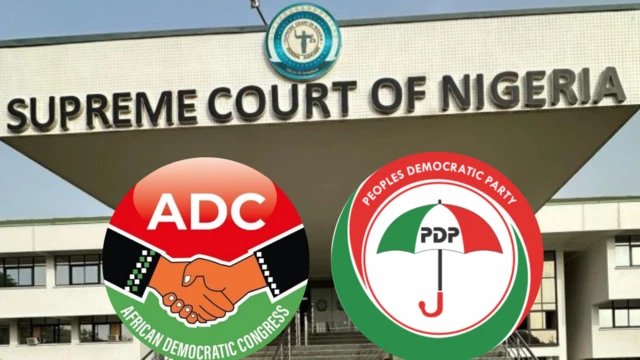
The Supreme Court, yesterday, reserved judgement in the appeals and counter-appeals arising from the leadership crises in the opposition parties of the Peoples Democratic Party, PDP, and African Democratic Congress, ADC, after hearing all parties. Accordingly, the apex court has kept mum on a date for its rulings, a decision that has varying implications for the feuding camps in both parties.
In the PDP, the case has already reshaped the party’s leadership, with earlier court decisions nullifying its Ibadan convention that produced Kabiru Turaki as national chairman and upholding the suspension of key officials.
Going by that, the PDP national executive, backed by the Federal Capital Territory, FCT, minister, Mr Nyesom Wike, and that which is recognised by the Independent National Electoral Commission, INEC, will hold sway, pending the verdict.
However, in the case of the ADC, the future appears bleak, as none of its three factions, led by Senator David Mark, Nafiu Bala Gombe and Ogga Temitope, is recognised by the electoral commission.
Going by the current electoral law, all the registered political parties have up till May 10, 2026, to submit their membership registers to INEC, or they would not be eligible to sponsor any candidates for the 2027 general election.
This means if the Supreme Court did not deliver its verdict within 18 days, the ADC will not be on the ballot.
We are waiting for the Judiciary – the Turaki-led PDP
After proceedings at the apex court, where the appeals challenged judgements delivered by Justices Omotosho and Lifu of the Federal High Court, Abuja Division, and affirmed by the Court of Appeal, the Turaki-led PDP faction, in a statement by its National Publicity Secretary, Ini Ememobong, said it expected justice from the court.
The Court of Appeal had upheld the earlier rulings of the Federal High Court, which nullified the PDP’s convention, held in Ibadan, and sustained the suspension of several party officers, including Samuel Anyanwu and A.K. Ajibade, SAN.
Dissatisfied with the rulings, the Wike-backed PDP approached the Supreme Court, asking it to declare that both the trial court and the appellate court lacked jurisdiction to entertain the matter, insisting it arose from the internal affairs of the party.
Also dissatisfied, the respondents, led by Anyanwu, filed a cross-appeal, urging the apex court to set aside the aspect of the judgement that upheld the suspension of Ajibade, Anyanwu and others.
“All parties adopted their respective processes,” Ememobong said, adding that after hearing arguments, the court reserved judgement to a date to be communicated to counsel.
He said, “We charge all true and uncompromised PDP members to keep their faith alive."
He explained that his party remained optimistic that the apex court would deliver judgements that would preserve multi-party democracy as against the emergence of a one-party state.
“The Supreme Court has, at several times in the history of our non-linear democratic experience, remained the last hope of Nigeria and Nigerians, even in the face of immense pressure and unimaginable risk,” Ememobong concluded.
We’re sure of victory — Bolaji Abdullahi.
National Publicity Secretary Malam Bolaji Abdullahi said a five-member panel of the apex court, headed by Justice Mohammed Garba, has reserved ruling on the ADC matter for judgement after hearing from all parties, , of the Mark-led faction, but his party is sure of victory.
Abdullahi said, “We are optimistic about the fact that the things came up quickly and the Supreme Court is mindful of the exigency of the moment." We are optimistic that their ruling will be in record time and quite optimistic of the ruling going in our favour."
The appeal, case file SC/CV/180/2026, filed by Senator David Mark.
The appellant, who leads a faction backed by frontline opposition figures, seeks to set aside a March 12 Court of Appeal judgement, which he said was against the interest of justice.
He argued that the appellate court exceeded its jurisdiction by ordering maintenance of the status quo ante bellum in a suit filed by aggrieved party members led by Nafiu-Bala Gombe.
Mark insisted that the courts lacked jurisdiction to intervene in a dispute involving a political party’s domestic affairs.
Besides Gombe, other respondents in the appeal include the ADC; the National, Rauf Aregbesola; the Independent National Electoral Commission, INEC; and the immediate past national chairman of the party, Chief Ralph Nwosu.
Mark demands, among other reliefs, an order restraining INEC from recognising anyone other than him and the current national officers, pending determination of the appeal.
He also requested an order barring INEC from altering the party’s leadership structure as currently constituted and staying proceedings in Suit No. FHC/ABJ/CS/1819/2025 currently before Justice Emeka Nwite at the Federal High Court, Abuja, until the appeal is heard.
While adopting their brief of argument, Mark’s legal team, led by Mr Jubril Okutepa, SAN, insisted the dispute was a non-justiciable internal party matter, as previously held by the Supreme Court.
Although INEC did not file any process to either support or counter the appeal, all the other respondents, however, urged the apex court to dismiss it for lack of merit.
They maintained that the trial court was properly seized of the facts of the case that was still pending before it.
INEC had removed Mark and Aregbesola from its portal and website as ADC National Chairman and Secretary, respectively, on April 1, citing the Court of Appeal’s judgement.
INEC claimed it would, in line with the order for maintenance of the status quo ante bellum, not recognise any of the warring factions until the legal dispute was determined.
However, despite INEC’s action, which the Mark-led faction has asked the Supreme Court to nullify, ADC vowed to proceed with its scheduled national convention.
Justice Nwite of the Federal High Court had, on April 14, adjourned sine die (indefinitely) the hearing of the substantive case that Gombe filed to sack the Senator Mark-led leadership of the ADC.
Justice Nwite said he could not proceed with the matter in view of the related issue before the Supreme Court.
He ruled that proceeding would amount to “judicial rascality” while the related appeal is pending before the Supreme Court.