


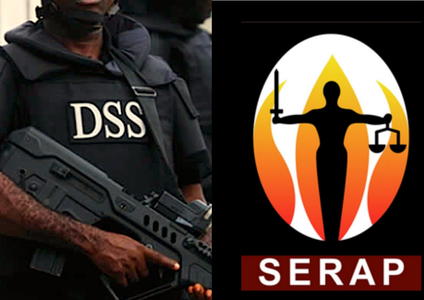
The Socio-Economic Rights and Accountability Project has appealed the Federal Capital Territory High Court in Abuja's ₦100 million defamation ruling against it, which favored Department of State Services officers. The organization called Justice Yusuf Halilu's May 5, 2026, ruling "a travesty and a miscarriage of justice" in a statement released on Tuesday by SERAP Deputy Director Kolawole Oluwadare.
Senior counsel Tayo Oyetibo submitted the appeal and a motion for a stay of execution until the appeal's outcome on Friday, May 8, 2026, according to SERAP.
"The Notice of Appeal already filed will be amended upon receipt of the Certified True Copy of the judgment to incorporate key portions of the judgment that further highlight its flawed nature," according to SERAP.
The appeal and associated stay of execution application, according to the organization, offer "adequate legal protection" while further proceedings are underway.
Due to articles on SERAP's X handle claiming that DSS agents illegally occupied its Abuja office in September 2024, Justice Halilu ordered SERAP to pay ₦100 million in damages to DSS officials, Sarah John, and Gabriel Ogundele.
In addition to paying ₦1 million in litigation costs and 10% yearly post-judgment interest until complete payment, the court ordered the organization to issue an apology on its website, newspapers, and television stations.
SERAP said in its appeal that the ruling was "unsupported by evidence, procedurally flawed, and legally defective."
The ruling is based on basic legal and factual mistakes that undermine jurisdiction and adjudication fairness. As a result, the court's ruling is flawed and invalid, according to SERAP.
The group further contended that the trial court used faulty evidence, such as a witness statement that it asserted was not taken under oath by a Commissioner for Oaths.
It stated, "The lower court erred in law by relying on the first respondent's witness statement under oath when the first respondent admitted under cross-examination that the said statement was not sworn before a Commissioner for Oaths."
Additionally, SERAP contested the court's defamation ruling, claiming that the publications did not specifically name the DSS officers.
The appeal stated, "The publications complained of did not mention the Respondents by name, rank, photograph, or any unique identifier."
The group argued that rather than using the objective legal standard necessary in defamation proceedings, the trial court improperly relied on the subjective opinions of DSS employees.
Additionally, SERAP contended that its justification, qualified privilege, and fair comment defenses were not upheld by the lower court.
It said, "There was evidence that SERAP made the publications on an occasion of qualified privilege to inform the public about actions of state security agencies that reasonably appear intrusive and intimidating."
The organization also asserted that the DSS authorities were unable to demonstrate that the release actually caused financial or reputational harm.
According to SERAP, "the Respondents did not adduce evidence of any suspension, investigation, disciplinary proceedings, or professional setback allegedly caused by the publications."
SERAP cautioned in its request for a stay of execution that carrying out the ruling could seriously impair its business operations and interfere with existing initiatives for human rights advocacy and accountability.
"SERAP, Nigeria's leading accountability non-profit organization dedicated to the promotion of human rights, rule of law, transparency, and accountability in governance, will have its operations severely disrupted, if not completely shut down, as a result of the Court's decision," the organization said.
"Thousands of people and communities depend on SERAP's work, including victims of human rights violations and beneficiaries of its advocacy, investigations, and legal interventions," the statement continued.
Additionally, SERAP contended that its constitutional right to file an appeal would be impacted by the judgment's rapid enforcement.
"SERAP would not be able to adequately finance the prosecution of its appeal to the Court of Appeal if the judgment were enforced, depriving it of its constitutional right to appeal," the statement stated.
The case started with a lawsuit that DSS officials filed in response to posts that SERAP published on September 9, 2024, claiming that DSS personnel harassed its employees and illegally occupied its office.
According to Justice Halilu's ruling, the publication was defamatory and had a negative psychological impact on the claimants.
The judge had decided that "SERAP must exercise caution and due diligence before tweeting or disclosing any specific information regarding the action of an agency of government for public consumption."
The court granted ₦100 million, calling it "a paltry sum," despite the claimants' initial request for ₦5 billion in damages.