


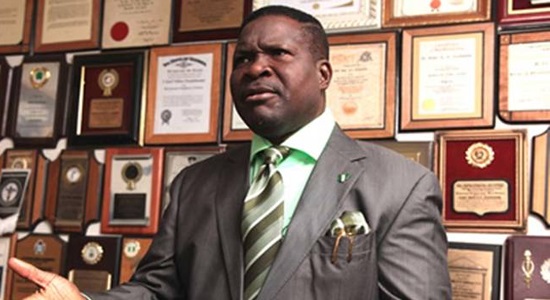

According to the Federal Government, in an effort to mitigate the impact of economic shocks, approximately 15 million households at risk have been added to its Benefit Register for conditional cash support, provided in collaboration with the World Bank. In a Friday interview with Arise Television, Dr. Bernard Doro, Minister of Humanitarian Affairs, Disaster Management, and Poverty Reduction, revealed this.
Not every home on the National Social Register is eligible for direct financial assistance, he clarified.
"In partnership with the World Bank, we are currently providing conditional cash assistance, but this money is really intended as a shock response," he stated. Therefore, not all of the 17.9 million households listed are on the Benefit Register. There are almost 15 million needy households on the Benefit Register.
Doro emphasized that beneficiaries for particular interventions are chosen independently, depending on program objectives, even though the National Social Register currently includes around 17.9 million vulnerable households that have been identified through community-based assessments and socioeconomic data.
He asserts that rather than being a universal benefit for everyone listed in the larger social register, the conditional cash assistance program is intended as a short-term solution to help households experiencing financial difficulties.
In a move to promote focused poverty reduction initiatives, Doro revealed that over 70 million Nigerians have been listed as vulnerable individuals in the National Social Register.
According to him, the number reflects roughly 17.9 million vulnerable households that have been recognized nationwide so far.
Since the focus began with the poorest of the poor, he claimed that every impoverished person in the nation had been apprehended thus far. Approximately 70 million people are listed in the registry as of right now, with 17.9 million vulnerable households registered. In order to include as many people as possible, we are keeping the register open.
Doro clarified that local communities are crucial in identifying vulnerable people, adding that the register's main goal is to identify the poorest of the poor through socioeconomic assessments and community interaction.
Communities will direct us based on the questions we have and the standards we have to determine who is impoverished among them, he said. In order to determine who is the poorest of the poor, we next take steps to confirm these when we visit their homes, inspect the state of the houses, and look at their personal information.
He emphasized that beneficiaries are chosen through a separate Benefit Register based on particular programs, and that being listed on the National Social Register does not automatically qualify people for direct financial assistance.
"We want to make sure that the National Social Register includes every Nigerian. Additionally, there is a distinction between the Benefit Register and the National Social Register for context. Therefore, when programs are planned, you target people according to the type of program you are providing," he continued.
The minister went on to say that the Federal Government will keep growing the National Social Register while making sure that those most impacted by vulnerabilities and economic shocks received tailored solutions.