


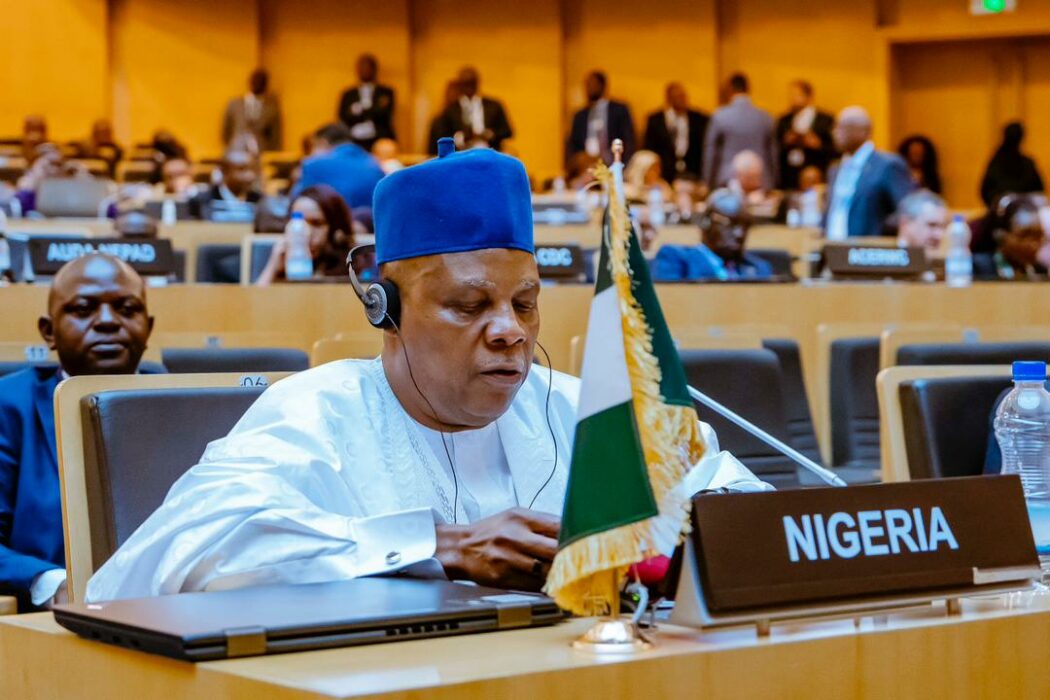
Nigeria has pledged full support for the African Union's far-reaching institutional reform agenda, committing to implement measures aimed at strengthening peace and security structures, deepening democratic governance, and expanding cooperation with international financial institutions and the private sector. The commiment was delivered by President Bola Tinubu through Vice President Kashim Shettima at a closed session of the 39th Ordinary Session of the Assembly of Heads of State and Government of the African Union in Addis Ababa, Ethiopia.
Aligning with proposals presented at the summit, Nigeria endorsed restructuring initiatives to improve domestic and regional mobilisation for affordable development financing. It also backed the adoption of a continental framework to reduce inequality, anchored on credible data systems, social protection mechanisms, productive employment and inclusive industrial policies.
On regional security, Shettima commended the AU Peace and Security Council for endorsing the Combined Maritime Task Force for the Gulf of Guinea as a standby force to deliver rapid, coordinated responses to maritime threats across the sub-region.
He assured member states that Nigeria would fulfil its obligations toward establishing the force and strengthening the African Union Standby Force, while warning that the proliferation of small arms and light weapons remains a major driver of conflict and violent extremism across the continent.
As host of the task force headquarters, Shettima said Nigeria would provide critical infrastructure, including office facilities, maritime vessels, helicopters and temporary personnel to ensure the force’s operational effectiveness.
On governance reforms, Nigeria supported proposals to refine criteria for membership of the AU Peace and Security Council and advocated clearer modalities for cooperation between the continental body and Regional Economic Communities to enhance predictability and effectiveness in peace and security management.
The Vice President also underscored the need for closer coordination between the Peace and Security Council and the Committee of Ten Heads of State and Government on United Nations Security Council Reform to strengthen Africa’s position in global governance discussions.
Reaffirming Nigeria’s commitment to democratic norms, Shettima backed reforms to strengthen democratic institutions across Africa and commended ongoing AU efforts to address unconstitutional changes of government. Nigeria also welcomed the lifting of sanctions on Gabon and Guinea following their political transitions, urging other nations in prolonged transitions to pursue reintegration.
On economic transformation and food security, Nigeria stressed that Africa’s critical mineral resources must drive industrialisation and structural transformation, calling for coordinated policies on local processing and manufacturing. Shettima further welcomed the G20 Ubuntu approach to food security, encouraging responsible private sector participation and greater investment in storage, logistics, research, climate-resilient agriculture and support for smallholder farmers, particularly women and youth, as other leaders echoed calls for stronger institutions and a unified African voice in global affairs.