



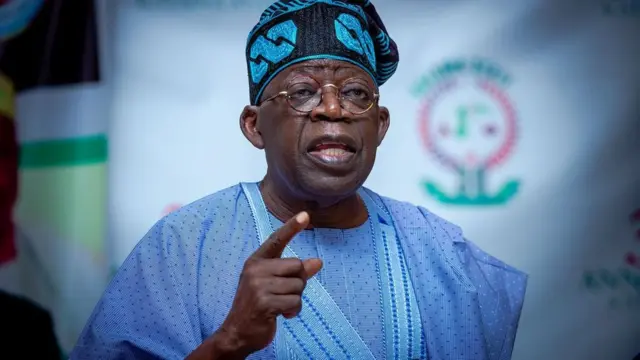
As the Federal Government announced the National Industrial Policy 2025 in Abuja on Tuesday, President Bola Tinubu stated that the persistent rally on the Nigerian Exchange demonstrates the improving health of the Nigerian economy and increased investor confidence. Speaking during the official national introduction of the policy, which had as its topic "From productivity policy: Implementing Nigeria's industrial future," the President said that the stock market's impressive performance demonstrated the nation's tenacity in the face of ongoing economic difficulties.
"Anyone following the trend in the Nigerian stock exchange would be overexcited," stated Tinubu, who was represented at the occasion by Vice President Kashim Shettima.
For someone like me, the extraordinary increase in stock value even fascinates me. Why? The state of the Nigerian economy is reflected in it.
"My friend called me yesterday because he was afraid that the value of his stocks had risen by N1.7 billion in just one day. The vitality was evident from that. Notwithstanding all the drawbacks, Nigeria is a wonderful country.
Top government representatives, business leaders, investors, and development partners attended the ceremony to see the new industrial roadmap unveiled.
Economic reforms, changes in the foreign exchange market, increased company profits, and rekindled investor interest have all contributed to the Nigerian stock market's recent year-long bull run.
Tinubu went on to emphasize the administration's resolve to restore Nigeria's standing as a competitive industrial economy.
In order to stay ahead of the curve in this industrial revolution, we need to build the infrastructure necessary to compete globally. We have to prepare before we can compete. And as we announce the Nigeria Industrial Policy 2025, I am thrilled to share the potential of this day," he remarked.
He claimed that much thought and discussion with national stakeholders resulted in the policy.
This policy, he said, is the result of careful reflection and a plan for re-engineering our industrial base, releasing value across industries, and putting jobs, production, and competitiveness at the core of Nigeria's economic strategy.
We have struggled for far too long with disjointed value chains, exorbitant production costs, deficiencies in infrastructure, inconsistent policies, and inadequate industry-government collaboration. This is over.
"Industrialization is not something you wish for. It is something that you do.
According to Tinubu, the strategy supports the government's local content and export diversification drive, trade goals under the African Continental Free Trade Area, and macroeconomic reforms.
It promotes value chain development, allowing Nigeria to gradually transition from exporting raw resources to manufacturing final goods. Because success shouldn't be exclusive, it incorporates our micro, small, and medium-sized businesses into the core of industrial progress.
This policy's emphasis on implementation is its defining feature. The quantity of documents we generate will not be used by this administration to gauge our success. Success will be determined by how many factories are opened, how many jobs are generated for our youth, how many exports leave our shores with the Nigerian quality mark, and how much value is kept in our economy," he stated.
Tinubu emphasized the private sector's pivotal role in propelling economic expansion, claiming that the government would foster an atmosphere that is favorable to enterprises.
"It is not the government's place to operate. Wealth is created by you.
Despite all the difficulties, we are really proud of the manufacturers in this nation. "You are actually producing your own energy," he remarked.
"In 2025, the Dangote industries, the cement sector alone, paid us N900 bn in taxes," he said, praising businessmen for their economic efforts, especially Aliko Dangote. This is how economies expand. This is how jobs are created.
As an illustration of a controlled industrial policy, John Enoh, the Minister of State for Industry, Trade, and Investment, had emphasized the effect of the government's restriction on the export of raw shea nuts.
"In August 2025, Mr. President made a tough but essential decision: banning the export of raw shea nuts," he wrote.
Many questioned the decision's wisdom at the time. However, conviction is what defines leadership, not ease of use.
over 95% of the world's shea nut output occurs in the West African region, with Nigeria producing over half of it. However, almost all of it left our borders in unprocessed form prior to 2025. The shea sector is worth around $6.5 billion worldwide, yet Nigeria only received 1% of that total. Jobs were exported. Our industry was exported. We exported the chance.
According to Enoh, the program has revolutionized the industry, increasing local processing and farmer revenues.
Nigeria no longer exports shea nuts as its main product. Shea butter is exported from Nigeria.
Shea butter is exported from Nigeria. At the same time as farmer incomes have increased dramatically, crushing capacity currently reaches 300,000 metric tonnes annually. Within a year, shea butter exports rose by 250 percent, he claimed.
"This policy did more than just build factories. It gave rural communities a sense of dignity. It produced industrial jobs. It boosted confidence across the country.
Boye Olusanya, the Group Managing Director and Chief Executive Officer of Flour Mills of Nigeria, also stated during a fireside conversation that the policy will speed up investments in a variety of industries.
"We are long-term participants in Nigeria and have been here for a long time. However, this policy will hasten the process of making investments. We'll see more investment because confidence is fueled by transparency and predictability," he stated.
Poor electrical supply, high production costs, inadequate infrastructure, restricted access to financing, and inconsistent policies have long plagued Nigeria's manufacturing industry. These difficulties have limited industrial expansion and increased the country's reliance on imports.
The new strategy aims to close execution and coordination gaps while building on earlier initiatives, such as the Nigeria Industrial Revolution Plan, which was unveiled in 2014.
A successful implementation of the roadmap, according to manufacturers, could increase exports, strengthen value chains, lower unemployment, and increase productivity in Africa's largest economy.
Tinubu was hopeful that Nigeria might use its sizable market and youthful population to propel economic development.
Nigerians are 16.9 years old on average. We are the workforce of the world. Africa is a relatively new continent. "Nigeria's industrial future is achievable if we come together behind this vision and pursue it with discipline," he stated. "The work has just begun. Not tomorrow. Not the following year. Right now.