


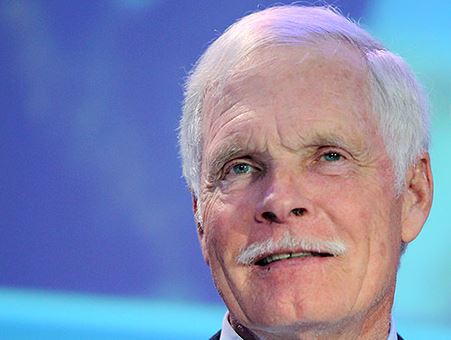
Media mogul Ted Turner, the pioneering force behind the modern 24-hour news cycle, has died at the age of 87, his network confirmed on Wednesday. Turner, who founded CNN in 1980, transformed global media by introducing the first dedicated rolling news channel, reshaping how audiences consumed information. Announcing his death, CNN chairman and CEO Mark Thompson paid tribute to Turner's legacy and leadership. "Ted was an intensely involved and committed leader, intrepid, fearless and always willing to back a hunch and trust his own judgement," he said.
“He was and always will be the presiding spirit of CNN. Ted is the giant on whose shoulders we stand, and we will all take a moment today to recognize him and his impact on our lives and the world,” Thompson added.
Born Robert Edward Turner III on November 19, 1938, in Cincinnati, he later moved to Savannah, Georgia, where his father ran a billboard advertising business. Following his father’s death in 1963, Turner took over the company and began building what would become a vast media empire.
His entry into television came in 1970 with the acquisition of a struggling Atlanta UHF station. By 1975, he had pioneered the concept of the “superstation,” using satellite technology to broadcast nationally, laying the foundation for Turner Broadcasting System (TBS).
Turner expanded his influence further by purchasing the Atlanta Braves baseball team, ensuring their games were broadcast on his network, a move that blended sports ownership with media strategy.
The launch of CNN in 1980 marked his most defining achievement. The network’s global reach grew rapidly, eventually broadcasting to millions of households and spawning related channels including CNN International, TNT, and Cartoon Network.
In 1996, Turner sold Turner Broadcasting to Time Warner in a $7.3 billion stock deal, later serving as vice chairman before stepping down from the board in 2006.
Beyond business, Turner was a prominent philanthropist and environmental advocate. Through the Turner Foundation, he supported conservation initiatives and helped promote environmental awareness, including backing the animated series Captain Planet and the Planeteers.
He also pledged $1 billion to the United Nations in 1997, leading to the creation of the UN Foundation, and later founded the Nuclear Threat Initiative to address global security risks.
Turner’s personal life drew public attention, including his marriage to actress Jane Fonda. In her memoir, she recalled moments of joy in their relationship, writing, “There were times when something would set us to laughing so hard we’d sink to the floor.”
In later years, Turner revealed he had been diagnosed with Lewy body dementia, describing it as “a mild case of what people have as Alzheimer’s… But not nearly as bad,” while candidly acknowledging memory struggles.
He is survived by five children, 14 grandchildren, and two great-grandchildren, leaving behind a legacy that reshaped global broadcasting and redefined the pace of modern news.
