


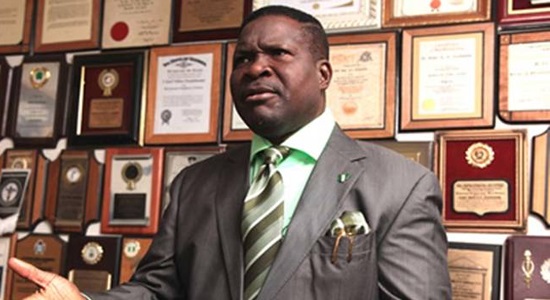

The Executive Secretary of the National Senior Secondary Education Commission (NSSCEC), Dr. Iyela Ajayi, during a press briefing held on Monday in Abuja, directed all state governments to comply with the newly approved minimum standards for Senior Secondary Schools within one year. Ajayi commended the Minister of Education, Maruf Alausa, and the Minister of State for Education, Suwaiba Ahmad, for their unwavering support towards the commission, stating that the NSSEC has been concentrating on establishing systems meant for transforming the quality, structure, and accountability of senior secondary education across the country.
He highlighted the release of the National Minimum Standards for Secondary Education in February as one of the Commission’s key achievements.
“The National Minimum Standards have to do with benchmarking requirements for all aspects of secondary education. How many teachers do you have? What should be their qualification? What should be the teacher-student ratio? The infrastructures that you have on the ground, and so on.’’ He said.
“The type of buildings you have, the quality of the buildings, all these are clearly spread out in the Minimum Standards.”
“We have developed the Minimum Standards, and it was launched in February this year. We have distributed the Minimum Standards to all the states of the Federation. We have given them 12 months within which to comply because the law establishing this commission has not only given us the power to produce Minimum Standards, but to enforce them.” He added.
According to the secretary, a one-year deadline has been set for state governments, after which NSSEC will commence nationwide enforcement inspections.
“There must be standards and uniformity. We cannot continue with a situation where students learn under trees or in classrooms without roofs. Those days must end.”
He noted the commission’s relentless efforts to improve teacher competence through ongoing professional development, such as training for English and Mathematics teachers, to capacity-building on AI-enhanced teaching techniques for educators and school administrators.
Ajayi also added that on curriculum reforms, NSSEC was actively involved in recent national updates, including the return of History as a subject, the reduction of curriculum overload, and the strengthening of skills-focused learning.
The NSSEC boss noted that, regardless of financial difficulties, the Commission has been able to facilitate the upgrade of 50 senior secondary schools, at least one in each state, through constituency projects. “These include new classrooms, laboratories, and ICT facilities. We are not yet like UBEC, but the little we have done is already changing the narrative,” he said.
Ajayi disclosed that NSSEC is in talks with telecom companies to provide subsidized broadband for schools and is collaborating with development partners to acquire 30,000 tablets for teachers across the country. He added that plans are in progress to make computer literacy mandatory for all students and to broaden learning opportunities in robotics, artificial intelligence, and data science.
However, he stressed that these goals are still constrained by a lack of adequate funding.
“Our major challenge is funding, funding, funding. The law provides 2 per cent of CRF for NSSEC interventions, but as I speak to you, not a kobo has been released,” he said.
The National Senior Secondary Education Commission is mandated to supervise and regulate senior secondary education in Nigeria, with a focus on policy formulation, quality assurance, and enforcing educational standards.
Its mission is to enhance student learning outcomes and ensure learners are adequately equipped for higher education and the job market. By establishing standards and offering support to schools, the Commission serves as a key driver in shaping the future of Nigeria’s youth and advancing national development.