
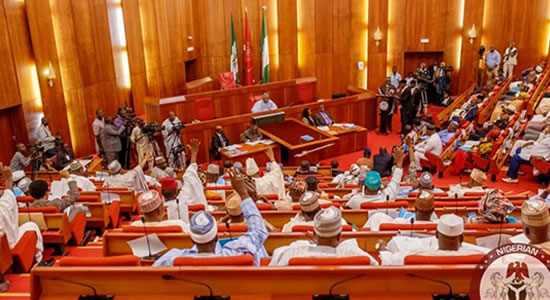
The Senate has told the Federal Government that borrowing remains unavoidable in the face of Nigeria's widening fiscal gap, but insisted that deficits must be clearly justified and funds deployed efficiently. Lawmakers, economic managers, and experts made the position known on Tuesday during a national public hearing on the 2027 Appropriation Bill held by the National Assembly in Abuja. Chairman of the Senate Committee on Appropriations, Senator Solomon Olamilekan Adeola, said borrowing was inevitable given Nigeria's vast infrastructure deficit and unpredictable revenue streams, but warned that the era of unchecked deficits and weak implementation must end.
He stressed that the problem was not borrowing itself but how deficits are financed and how borrowed funds are utilised. “On deficit financing, borrowing cannot be entirely avoided. Revenue inflows are unpredictable… What matters is not whether or not we borrow but how deficits are funded and how borrowed resources are deployed,” Adeola said.
According to him, the Federal Government is deliberately limiting domestic borrowing to avoid crowding out private sector credit, opting instead for a mix of external financing, asset optimisation, privatisation, Eurobonds and Public-Private Partnerships (PPPs).
Adeola noted that Nigeria’s debt burden has been aggravated by high servicing costs and legacy liabilities, citing past fuel subsidy payments largely funded through borrowing. “We budgeted up to N7 trillion annually for fuel subsidies that did not exist. We had to borrow. That cycle has now been broken,” he said, referencing President Bola Ahmed Tinubu’s subsidy removal policy.
He disclosed that the proposed 2026 budget projects total expenditure of N58.47 trillion against expected revenue of N33.19 trillion, leaving a deficit of N25.27 trillion, with debt servicing estimated at N15.90 trillion.
The committee chairman warned that the National Assembly would no longer approve extensions of budget implementation cycles, vowing stricter timelines and oversight. “Never again will the National Assembly approve budget extensions,” he said.
Adeola also called for expanded use of PPPs, full subsidy removal and the unbundling of the electricity sector to free up resources, noting that the budget tagged “Budget of Consolidation, Renewed Resilience and Shared Prosperity”prioritises security, infrastructure, education and health.
Minister of State for Finance, Dr. Doris Nkiruka Uzoka-Anite, said borrowing must be tied to reforms and tangible outcomes that directly impact households and businesses, acknowledging public frustration over rising living costs despite improved market confidence.
She described Nigeria’s recovery as fragile, adding: “For ordinary men and women, this shift is more significant than almost any other recent change. It affects livelihoods, infrastructure quality and the stability families need to thrive.”
Senate President Godswill Akpabio, represented by Deputy Senate President Barau Jibrin, described the budget as a moral test, saying: “Budgets are not mere rituals of governance… A budget is a moral document. It reveals priorities.”
Experts at the hearing warned that Nigeria’s rising deficit could become unsustainable without stronger fiscal discipline, with economist Dr. Olatilewa Adebanjo calling for stricter enforcement of the Fiscal Responsibility Act, while officials of the Public Complaints Commission decried abandoned projects, inflated contracts and weak execution by MDAs.