

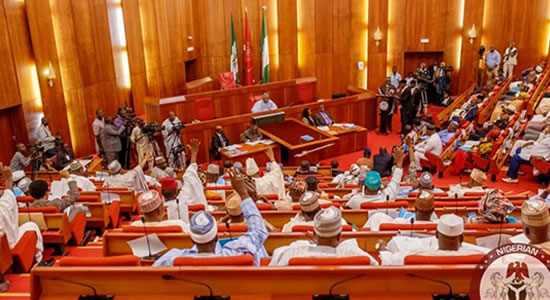
Senate President, Godswill Akpabio, has summoned an emergency sitting of the Senate for Tuesday, February 9, following widespread backlash over recent amendments to the Electoral Act, particularly the rejection of mandatory electronic transmission of election results ahead of the 2027 general election. The recall comes amid intense criticism from prominent Nigerians, opposition figures, civil society organisations, youth groups and organized labour, who accuse the National Assembly of attempting to dilute critical electoral reforms. A statement issued on Monday by the Clerk of the Senate, Emmanuel Odo, directed all senators to reconvene for the extraordinary plenary scheduled to commence at noon, although no official reason was given for the sudden recall.
Investigation revealed, however, that the emergency sitting is aimed at approving the Votes and Proceedings of the Senate's last sitting, a key procedural requirement for the conference committee on the Electoral Act Amendments Bill to begin its work. A ranking senator and principal officer confirmed the development, saying lawmakers had been formally notified, "We have been formally asked to reconvene on Tuesday to approve the Votes and Proceedings of our last legislative sitting. This is necessary to clear the way for the conference committee to begin work on the Electoral Act Amendments Bill," he said.
The senator added that the session might commence behind closed doors due to rising political tension surrounding the electronic transmission of results. “It is most likely that there will be an executive session before the main business of the day. The issue of electronic transmission of results has already generated serious tension within and outside the National Assembly,” he noted.
The decision to interrupt the Senate’s ongoing two-week recess, earmarked for engagements with ministries, departments and agencies on the implementation of the 2026 budget, underscored the urgency attached to resolving the Electoral Act controversy, which many observers say will shape the credibility of future elections.
Meanwhile, prominent Nigerians, including former Senate President David Mark, Femi Falana (SAN), Oby Ezekwesili, Pat Utomi, Ayuba Wabba, Usman Bugaje and Shehu Sanni have openly criticised the Senate’s position. Speaking at the public presentation of The Burden of Legislators in Nigeria in Abuja, Mark insisted that calls for mandatory electronic transmission of results were clear and non-negotiable. “The National Assembly should pass the law and let INEC complain if there is a problem,” he said, dismissing concerns about infrastructure challenges.
Mark’s remarks followed comments by Akpabio, who had urged critics to exercise patience, arguing that real-time electronic transmission failed to consider gaps in electricity and internet access in rural communities. Mark countered that such arguments weakened public confidence, stressing that electoral laws should protect the integrity of the vote and allow the Independent National Electoral Commission (INEC) to determine feasibility.
Pressure also mounted from civil society groups. A coalition of activists under the banner of the Movement for Credible Elections (MCE) rejected the Senate’s decision, describing it as an assault on Nigerians’ democratic rights. “This is not lawmaking, it is deliberate democratic sabotage… Mandatory electronic transmission of results is not controversial. It is a minimum safeguard against result tampering,” the group said, warning of mass civic action if the clause was not reinstated.
The ADC Diaspora Roundtable similarly accused the Senate of ignoring the will of Nigerians by deleting the phrase “real-time” from the amendment. “The refusal to make electronic transmission mandatory directly contradicts the clear demand of Nigerians for transparency and credibility in elections,” the group stated, warning that the move risked reopening wounds from disputed polls.
Youth groups were equally critical. The Youth-led Electoral Reform Project (YERP-Naija) Consortium described the Senate’s action as a setback to public confidence in electoral integrity, arguing that retaining discretionary powers for INEC weakened statutory clarity and accountability. However, the group urged the conference committee to use the harmonisation process as an opportunity for reconsideration.
Organised labour added to the pressure, with the Nigeria Labour Congress (NLC) warning of mass action or a possible boycott of elections if the amended law failed to mandate real-time electronic transmission of results. In a statement, NLC President Joe Ajaero said the amendment must give INEC an unambiguous mandate. “The path to the 2027 elections must be built on certainty, not confusion,” he said, insisting that Nigerians deserved a transparent electoral process where their votes would not only count but be seen to count.