
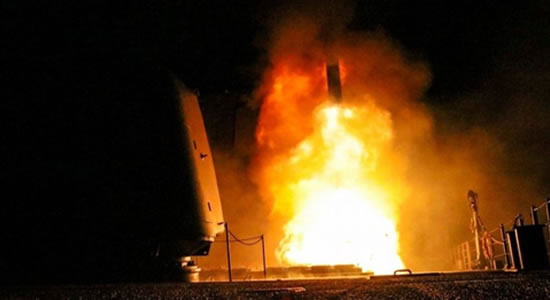
The United States and Israel launched coordinated strikes on Iran early Saturday, following what the Israeli military described as months of “close and joint planning.” Israeli officials said the operation targeted Iran’s top leadership, including Supreme Leader Ayatollah Ali Khamenei, President Masoud Pezeshkian and armed forces chief Abdolrahim Mousavi. US sources indicated the campaign could extend for several days.
President Donald Trump described the assault as “massive and ongoing,” cautioning that American lives could be at risk. He also called on Iranians to “take over your government,” signaling support for regime change as military operations unfolded.
Satellite imagery showed smoke rising from the compound of Khamenei in Tehran, a site long viewed as the nerve center of Iran’s clerical establishment. Multiple Iranian cities, including Isfahan and Qom, reported explosions, with residential districts in the capital appearing to sustain significant damage.
Iran responded with what it called an unprecedented wave of retaliation, launching “dozens” of ballistic missiles toward Israel and targeting US military installations across the Gulf. The Islamic Revolutionary Guard Corps said it struck Al-Udeid Air Base in Qatar, Al-Salem Air Base in Kuwait, Al-Dhafra Air Base in the UAE and a US naval facility in Bahrain, as well as positions in Jordan and Iraq.
Explosions reverberated across the region as missile defense systems were activated. In Israel, authorities issued repeated alerts warning of incoming fire, while motorists near Tel Aviv sheltered under highway overpasses. The Israeli military cautioned that additional waves of missiles were expected.
Iran also initiated what it described as a “large-scale” drone assault against Israel. Meanwhile, Qatar said a second wave of missiles aimed at its territory had been “intercepted and neutralized,” urging residents to remain calm.
Air travel across the Middle East was heavily disrupted. Dubai suspended all operations at its main airports, including Dubai International, one of the world’s busiest hubs for international passengers. Major global carriers canceled or rerouted flights as several countries closed or restricted their airspace.
Inside Iran, uncertainty persisted over the full extent of the damage and whether senior leaders had been harmed. State media reported that Pezeshkian and other top officials were safe. Authorities urged residents to evacuate parts of Tehran and avoid crowded areas, while insisting that fuel, medicine and essential goods remained “abundantly available.”
Iranian Foreign Minister Abbas Araghchi condemned the strikes as “a blatant violation of the fundamental principles of the UN Charter” and pledged that Iran would exercise its “inherent right of self-defense.” He warned that the “origin and sources of US and Israeli military operations” would be considered legitimate targets.
The strikes drew swift international reaction. European leaders expressed alarm, with European Council President António Costa and European Commission President Ursula von der Leyen calling the escalation “greatly concerning” and urging restraint. French President Emmanuel Macron warned of “grave consequences for international peace and security.”
Spain’s Prime Minister Pedro Sánchez said Madrid “reject(s) the unilateral military action of the United States and Israel,” while also condemning Iran’s conduct. Canada’s Prime Minister Mark Carney voiced support for US efforts to prevent Iran from obtaining a nuclear weapon. Russia’s diplomat Mikhail Ulyanov warned the attacks were “fraught with the danger of significant deterioration.”
In the Gulf, regional leaders reacted sharply. Oman’s foreign minister Badr Albusaidi said he was “dismayed” and urged Washington not to “get sucked in further,” declaring, “This is not your war.” Saudi Arabia labeled Iran’s retaliation “treacherous,” while Kuwait cited Article 51 of the UN Charter in defending its response.