


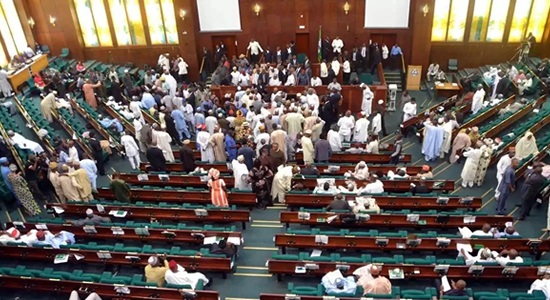
A proposed amendment to Nigeria's 2026 Electoral Act prescribing stricter penalties for dual party membership has sparked widespread debate across political circles, raising concerns about its implications for democracy ahead of the 2027 general elections. The House of Representatives recently passed the amendment, barely a month after the Electoral Act 2026 was signed into law by President Bola Tinubu. The new provision introduces tougher sanctions targeting individuals affiliated with more than one political party.
Under the amendment, offenders risk a fine of N10 million, a maximum of two years imprisonment, or both, alongside forfeiture of membership in all political parties. The bill also amends Section 77 of the Act, which governs political party membership.
The legislation, sponsored by the House Leader Julius Ihonvbere, states that, “A person shall not be registered as a member of more than one political party at the same time.
“Where it is established that a person is registered as a member of more than one political party at the same time, such dual membership shall be void, and the person shall cease to be recognised as a valid member of any political party pending regularisation, in accordance with the provisions of this Act and the constitution of the political party concerned.
“A person who knowingly registers or maintains membership in more than one political party at the same time commits an offence and is liable on conviction to a fine of N10 million or imprisonment for a term of two years or both.”
The proposal triggered sharp divisions among lawmakers during plenary, with some backing the measure as necessary to ensure political discipline, while others warned of potential constitutional conflicts.
Chairman of the House Committee on Solid Minerals, Jonathan Gaza, supported the bill, describing dual party membership as deceptive. In contrast, Chairman of the House Committee on University Education, Abubakar Fulata, argued the amendment could violate constitutional rights.
He said: “This proposed amendment seems to be in contravention of Section 40 of the Constitution of the Federal Republic of Nigeria, as amended, which guarantees the freedom of association at any time.
“Instead of denying the membership of two parties, I think we should recommend that you be limited to only one. Denying him the freedom to associate with all the political parties to which he might have belonged is a contravention of his right under Section 40 of the Constitution.”
Deputy Speaker Benjamin Kalu, who presided over the session, maintained that individuals should align with parties that reflect their ideological beliefs, describing dual membership as “fraudulent misrepresentation.”
Beyond the National Assembly, opposition figures and civil society voices have also criticised the proposal, warning that it undermines democratic freedoms and could tilt the political landscape in favour of the ruling All Progressives Congress (APC).
Among the critics, Social Democratic Party leader and 2023 presidential candidate, Adewole Adebayo, described the amendment as unconstitutional and politically motivated. “It is unconstitutional to punish a person for joining political parties. You cannot legislate that someone cannot join three political parties if they want to,” he said.
Adebayo further accused lawmakers of prioritising political interests over constitutional order, stating, “They are legislating for one person. What they are doing is legislative lynching.” He argued that while electoral rules require candidates to be sponsored by a single party, they do not prohibit broader political associations.
Legal analyst Maarcellus Onah also questioned the intent behind the bill, suggesting it reflects fears within the ruling party over potential defections amid economic and security challenges. “So, the proposed legislation is intended to prevent politicians within the ruling party from abandoning it if political conditions worsen,” he stated.
Onah criticised the National Assembly’s broader role, adding, “The National Assembly is the enabler of many of the problems we complain about. It is their constitutional duty to ensure that the executive obeys the constitution, but instead of rising to that important constitutional role, they simply choose to approve whatever is sent to them.”
Despite the APC’s dominant position, controlling a majority of governorships and legislative seats, analysts say the amendment signals underlying political anxieties. Responding to this, Adebayo noted that political dominance does not necessarily reflect public support, insisting, “The fact that you capture the governors does not mean the people are happy with you… It is the people who will have the final say.”